
您最多选择25个主题
主题必须以字母或数字开头,可以包含连字符 (-),并且长度不得超过35个字符
 The Dod
539f6f4f40
Add neo option, configurable videos
The Dod
539f6f4f40
Add neo option, configurable videos
|
1年前 | |
|---|---|---|
| HuzzahAPDistance | 1年前 | |
| static | 1年前 | |
| templates | 1年前 | |
| .gitignore | 1年前 | |
| README.md | 1年前 | |
| app.py | 1年前 | |
| requirements.txt | 1年前 | |
| run.sh | 1年前 |
README.md
README.md
Eye of Beholder
A work about false narratives, dead journalists, and not-so-innocent bystanders.
to be continued
Install distance sensor server (on Adafruit Feather HUZZAH ESP8266 board)
$ cd HuzzahAPDistance
$ cp config.h.example config.h # and edit it with SSID and Password for the AP (pick something hard to guess)
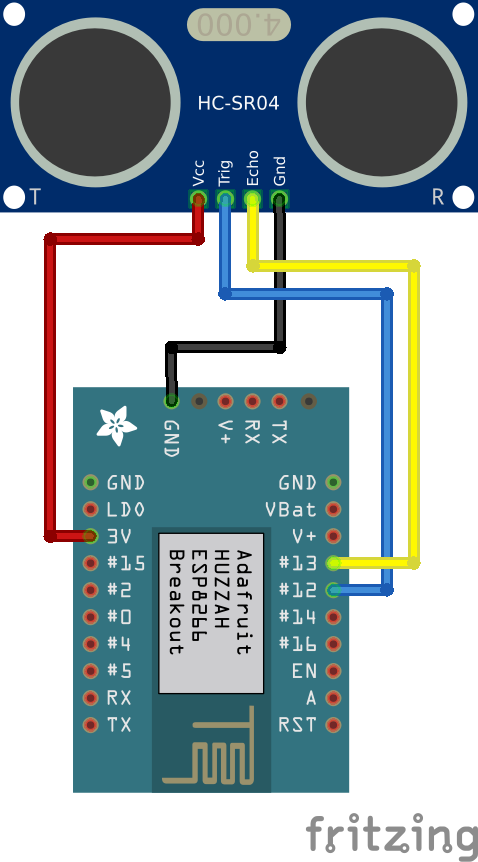
Upload to the Huzzah board, and connect it to HC-SR04 like this:
Test distance sensor server
Connect PC to the WiFi network you’ve defined at config.h
Browse to http://192.168.115.23. You should see a report of list of current client MAC addresses (typically, only yours), and a link to a JSON end point that returns distance.
Install web server (on linux PC)
$ virtualenv venv
$ . venv/bin/activate
$ pip install -r requirements.txt
$ cd ../static/js
$ cp config.js.example config.js # and edit it according to room size, etc.
Run web server
$ ./run.sh
Browse to http://localhost:5000 to see the work.
Browse to http://localhost:5000/p to see distance as a progress bar (this can help callibrate static/js/config.js)